In the quiet confectionery workshops of Nagasaki, where the air hangs thick with the scent of eggs and caramelizing sugar, a centuries-old dance between batter and syrup unfolds. The creation of Castella, that deceptively simple Portuguese-derived sponge cake, is a study in precision and patience, a culinary art where the most critical battles are fought not with complex ingredients, but against the very air itself. Two processes stand as the ultimate determinants between a masterpiece and a mediocrity: the meticulous management of batter aeration and the final, transformative act of sugar syrup brushing. These are not mere steps in a recipe; they are the heart of the craft.
The journey of Castella begins with its soul—the meringue. Unlike western sponges that often employ chemical leaveners, Castella relies solely on the air trapped within the protein matrix of whipped eggs for its rise. This is the first and most fragile frontier. The baker’s goal is to achieve a foam of staggering stability, a meringue whipped to stiff, glossy peaks that can shoulder the weight of the flour and honey without collapsing. The type of sugar used is paramount; a fine-grained caster sugar is preferred as it dissolves rapidly during whipping, creating a denser, more stable syrup within the egg whites that strengthens the protein walls of each air bubble. Under-whipping leaves the structure weak and incapable of supporting the forthcoming additions, while over-whipping introduces a dryness and a brittleness that will lead to large, uneven tunnels and a catastrophic collapse later in the oven.
Then comes the moment of greatest peril: the incorporation of the flour and the additional egg yolks. This is the folding stage, a gentle, deliberate sinking and turning motion with a spatula. The objective is to combine the elements with absolute minimal force, to sacrifice as few of those precious, hard-won air bubbles as possible. An aggressive hand, a few impatient strokes—this is all it takes to initiate a process bakers fear most: batter deflation. The visual sign is a batter that loses its lofty, cloud-like height and becomes thinner, almost soupy. The consequence in the baked cake is a dense, damp, and rubbery crumb, a texture the Japanese call beta-beta, the polar opposite of the desired fine, moist, and springy fuwa-fuwa texture. It is a loss of lightness, a collapse of ambition at the hands of haste.
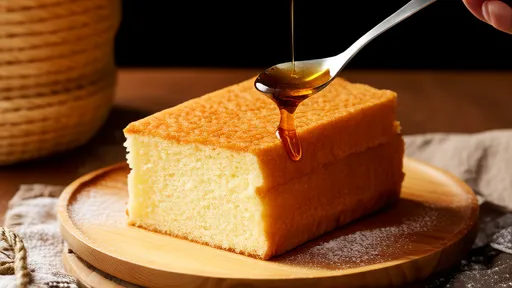
Even if the batter is perfectly aerated and baked to a perfect golden-brown, the cake’s story is not complete. Straight from the oven, the crust is dry and the interior, while cooked, has not yet achieved the legendary moistness that defines a superior Castella. This is where the second act of alchemy occurs. A simple syrup, often infused with the subtle sweetness of mizuame (barley malt syrup) for depth and sheen, is prepared. While the cake is still radiating heat from its core, it is meticulously brushed, sometimes even sprayed, with this syrup. The science is elegant: the residual heat of the cake instantly pulls the thin syrup past the crust and into the uppermost layers of the crumb. This does several things at once. It replaces moisture lost to evaporation during baking, guaranteeing that iconic, almost damp tenderness. It adds a subtle gloss to the top crust, making it visually appealing. Most importantly, it contributes a nuanced sweetness that complements rather than overpowers the rich egg flavor.
The timing and technique of this application are everything. Apply the syrup too early or too liberally, and the top becomes sodden and sticky, compromising the structural integrity of the delicate crust. Apply it too late, when the cake has cooled, and the syrup will simply sit on the surface, creating an unpleasant wet film without penetrating the interior. The master baker knows to apply multiple thin layers, allowing each to be absorbed fully before adding the next, patiently building the moisture content without overwhelming the structure. This process is what transforms a baked good from merely finished to fully matured and rounded in flavor.
Finally, the cake is wrapped tightly and left to rest, or jikkan, for a minimum of twelve hours, often a full day. This resting period is the final, silent partner in the process. It allows the moisture from the syrup to redistribute evenly throughout the entire loaf, from the syrup-blessed top to the drier bottom. The flavors, once distinct and sharp from the oven, meld and mellow into the harmonious, complex whole that is Castella. The crumb settles into its final, impossibly uniform and velvety texture. To slice into a Castella before its rest is to experience a cake incomplete, its potential unfulfilled.
In the end, the perfect Nagasaki Castella is a testament to control. It is a victory over gravity and impatience. The vigilant prevention of batter deflation builds the architectural wonder of its airy structure, while the strategic application of sugar syrup provides the lifeblood of moisture and flavor that elevates it from a simple sponge to a cultural icon. Each slice, with its signature honeycomb crumb and deep golden hue, is not just a taste of history, but a physical record of a baker’s successful navigation of these two delicate, defining processes. It is a quiet, edible proof of mastery.
By /Aug 20, 2025
By /Aug 20, 2025
By /Aug 20, 2025
By /Aug 20, 2025

By /Aug 20, 2025

By /Aug 20, 2025
By /Aug 20, 2025
By /Aug 20, 2025
By /Aug 20, 2025
By /Aug 20, 2025
By /Aug 20, 2025
By /Aug 20, 2025
By /Aug 20, 2025
By /Aug 20, 2025

By /Aug 20, 2025
By /Aug 20, 2025
By /Aug 20, 2025
By /Aug 20, 2025
By /Aug 20, 2025

By /Aug 20, 2025
